
2019 SYMPOSIUM
2019 Alderney Symposium
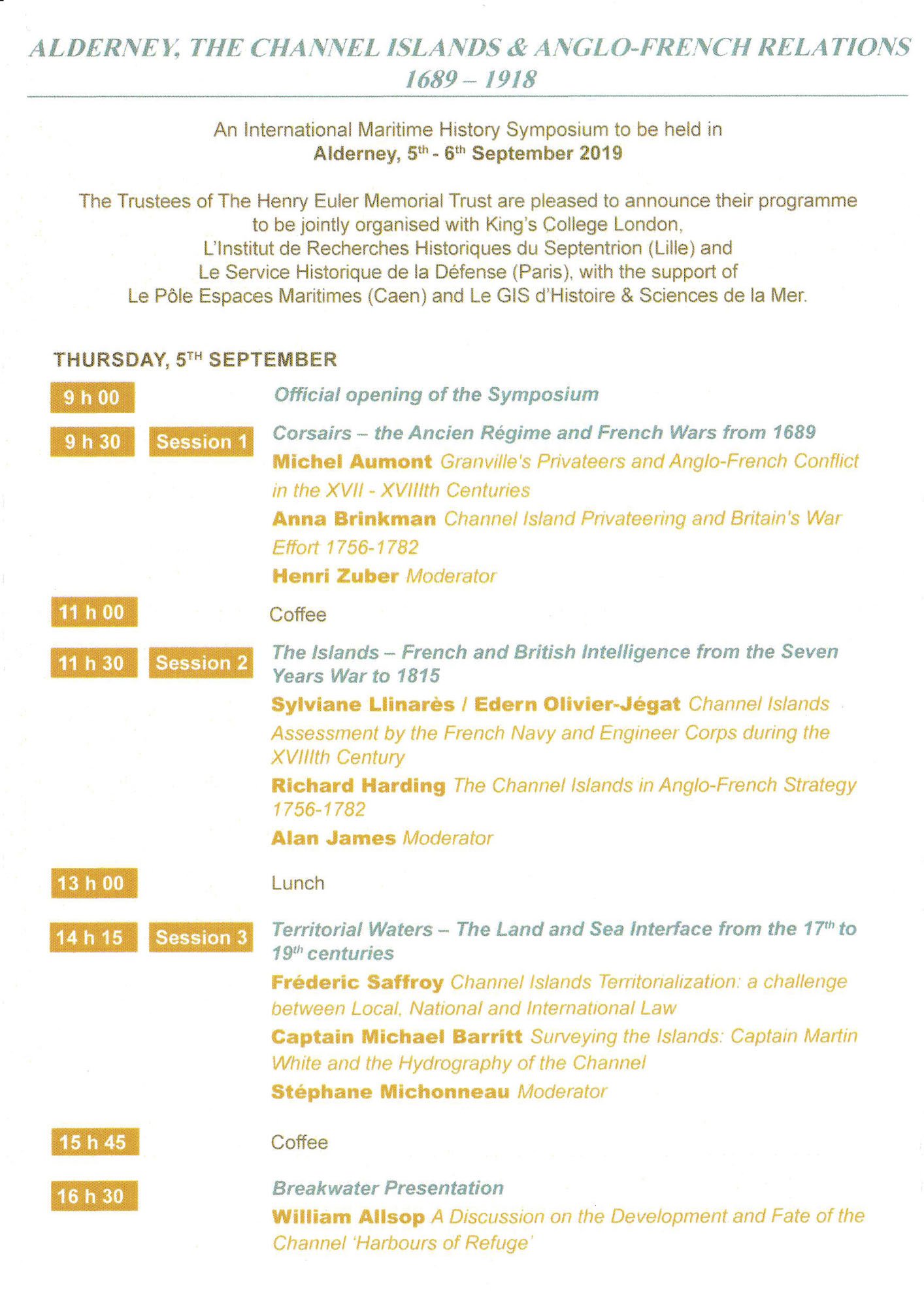
On September 5th and 6th 2019, THEMT hosted an international Symposium and exhibition in Alderney.
The Symposium showcased and celebrated Alderney’s maritime history and heritage by placing the island within the context of Anglo-French rivalry from the end of the 17th century to the First World War, with a full programme of public lectures, discussion and presentations across the two days.
Our purpose was to understand the Channel Islands and the role played by Alderney in the wider context of Anglo-French relations between 1689 and 1918. This will complemented existing scholarship which has tended to treat them as a place apart. In reality, every aspect of their existence has been influenced by their relationship with the English/British state.
Nowhere is this more obvious than in the connection between their strategic location, which was of immense importance in any Anglo-French conflict, and the role local bases, resources and, above all, maritime expertise could play in any such conflict. The Islands shaped national strategies in war and peace for two hundred years, and strategy shaped the Islands in equal measure.
You can dive deeper into the details of the symposium on this page and find even more information in the book that will be published 16th of January 2024.


Speakers
-
was elected Chairman of the Société française d’histoire maritime (SFHM) in 2017, under the patronage of UNESCO. He obtained a PhD in June 2010 from the University of Caen Basse-Normandie with a doctoral thesis on the privateers of the French harbour of Granville in Normandy (1688-1815). He has since broadened his research into new areas and topics concerning maritime history generally (fishing, economy, populations, life on board, etc.). He is frequently invited to present lectures, and regularly publishes articles and books on these subjects. He recently retired from the University of Caen in Normandy as chargé de cours, where he qualified as a university lecturer in 2012. He is still a researcher at the Centre de recherches d’histoire quantitative (CRHQ) at Caen University, specialising in French and Channel privateering and European maritime history. He is currently working on a collaborative study of European privateer captains for a critical survey of French sea power from the 1540s to 1815.
-
is a lecturer in the Defence Studies Department at King's College London. She was awarded her PhD from the Department of War Studies at King's in 2017, focussing on eighteenth century prize law as an instrument of British foreign policy towards Spain and Holland. After her PhD she was a Post-Doctoral Research Fellow in the Department of Hispanic Studies at the University of Warwick, working on the AHRC funded project 'Imperial Entanglements: Transoceanic Basque Networks in British and Spanish Colonialism and their Legacy.' Her research now focuses on the history of maritime strategic thinking and international law in the eighteenth and nineteenth centuries.
-
is a Fellow of the Royal Historical Society and Professor Emeritus at the University of Westminster, where he was head of the Department of Leadership and Professional Development from 2009 to 2016. His research specialisms are amphibious operations, naval leadership and the organisational development of navies. He is the author of numerous books including Seapower and Naval warfare, 1650-1850 (UCL Press, 1999); The Emergence of Britain's Global Naval Supremacy (Boydell, 2010); and Modern Naval History: Debates and Prospects (Bloomsbury, 2016). He is co-editor of Naval Leadership and Management, 1650-1950 (Boydell, 2013), from which position he is particularly qualified to examine the perceived role of the Channel Islands in the defence of Britain and the empire in the second half of the eighteenth century.
-
is a practising avocat à la cour working in Paris, specialising in regulatory and compliance matters in innovative defence, aerospace and life science industries, and is a member of IRHiS and GIS d'histoire et sciences de la mer. Since completing his PhD in history and the publication of his thesis under the title Le bouclier de Neptune (2015), his research has concentrated on the naval and maritime aspects of French defence policy during the Third Republic (1875-1940). His recent papers relate to innovation during two World Wars and the naval-industrial complex, the evolution of littoral warfare, cartography from Gallipoli (1915) to the Provence landing (1944), and the future challenge of Geographic Intelligence (GeoInt). Frédéric Saffroy is one of the contributors to the Dictionnaire Clemenceau (2018), and is a member of the Institut de stratégie comparée (ISC).
-
a past president of The Hakluyt Society and the recipient of the second Alexander Dalrymple Award for outstanding work in world hydrography, served as Hydrographer of the Navy from 2001 to 2003. His publications include Eyes of the Admiralty (2008) describing hydrographic activity of the Royal Navy during blockade of the French Channel coast in 1799-1800. He commanded the surveying ship HMS Bulldog in the SW Approaches to the English Channel in the 1980s, and his experiences of the challenges is used to confirm the achievement and deserved reputation of his precursor, Captain Martin White – a towering figure in the early history of the RN Surveying Service which was launched in the aftermath of the Napoleonic Wars. Martin White's devotion to duty, superior skills, meticulous attention to detail, and fine draughtsmanship first came to note during front-line wartime service in the testing waters of the Channel Islands.
-
founded his own consulting practice in 2017 having worked at HR Wallingford (previously the Hydraulics Research Station) for 48 years. As Technical Director for Maritime Structures, he was responsible for consultancy and research studies on breakwaters, sea walls and a wide range of shoreline, estuarial and coastal structures, as well as performance and certification of temporary flood prevention devices. He devised the UK's first laboratory tsunami simulators. He has cooperated on research projects to advance design methods for breakwaters and coastal structures in the UK, Europe and the USA, and is an Honorary Professor at University College London. His work has placed him in a unique position to assess the engineering background and performance of the Alderney breakwater as one of the Channel 'harbours of refuge', and the problems faced with its continuing maintenance.
-
is a Senior Lecturer at the University of Lille and directs the projet HIMARIAN (Histoire maritime des îles anglo-normandes) within the research unit IRHiS of which he is a member. He is also Head of the Research, Teaching and Studies Unit at the Historical Branch of the French Ministry of Defence (SHD) at Vincennes, as well as being a Lieutenant de vaisseau de reserve in the Marine nationale. He has participated in many international service and academic conferences on naval history and current affairs. Amongst a number of publications, he is the joint author of La Marine française sur les mers du monde 1860-1939 (2012) with Philippe Vial, and he has been co-editor of Entre terre et mer: l'occupation militaire des espaces maritimes et littoraux (2014) with Eric Grove and Andrew Lambert.
-
is Laughton Professor of Naval History in the Department of War Studies at King's College London. After completing his early research in the department, he went on to teach at the Royal Naval Staff College, Greenwich, and the Royal Military Academy, Sandhurst. He is Director of the Laughton Naval History Unit at King's, and a Fellow of the Royal Historical Society. He is the author of many books beginning with Battleships in Transition: The Creation of the Steam Battlefleet: 1815-1860 (Conway, 1984), through The Crimean War: British Grand Strategy Against Russia, 1853-1856 (Manchester, 1990) to The Challenge: Britain Against America in the Naval War of 1812 (Faber, 2012) for which he was awarded the Anderson Medal, and Seapower States; Maritime Culture, Continental Empires, and the Conflict that made the Modern World (Yale, 2018). Described as “the outstanding British naval historian of his generation”, his acclaimed history of the Royal Navy, War at Sea, was broadcast on BBC2. Commanding the Channel will provide a worthy medium for an exposition of Professor Lambert's scholarship.
-
teaches history at the French Naval Academy in Brest. She holds a PhD in history from the University of Southern Brittany at Lorient, with a dissertation on the history of French hydrography in the 19th century, in which the Dépôt des cartes et plans was responsible for collecting geographical data for producing nautical charts and providing the fleet and merchant seamen with nautical publications. Surveys were conducted by engineers and also by naval officers in a strategy aimed at defending the coasts in the event of a naval war against Great Britain. The difficult waters between the Channel Islands and the coasts of France hold a very special place in these plans. She is a member of the Fédération de recherche, histoire et archéologie maritime – Université Paris-Sorbonne, and has contributed articles to the Revue d'histoire maritime (25), Le navire à la mer with Olivier Chaline, and the Revue Maritime (495), Usages et représentations de la carte nautique du XVIIe au XIXe siècle.
-
lives in Alderney where he runs an architectural practice, is a founder trustee of The Henry Euler Memorial Trust and former consultant to the States of Guernsey's 'Fortress Guernsey' programme for the restoration and interpretation of that island's fortifications of all periods. He holds a degree from the Open University in comparative British and American history, is a past president and honorary life member of the Channel Islands Occupation Society (Guernsey) and was one of only three UK speakers invited to address the Vauban Tercentenary colloque at Cherbourg. Appointed O.B.E. for 22 years' voluntary service to the Court of Alderney, sixteen as chairman, he is the author of Hitler's Atlantic Wall (DI Pub., 1976), and co-author of Mirus: The Making of a Battery (Ampersand, 1983) and The Fortifications of Alderney (AFC, 1993). He is currently compiling the maritime archive database for The Henry Euler Memorial Trust, and will address the impact on Alderney arising from its nineteenth century strategic pre-eminence.
-
was a Research Fellow at the Navy’s Division of the Historical Branch of the French Ministry of Defence (SHD). He was in charge of the history of the French Navy between 1870 and 1945, investigating the role played by the navy in a global dimension including politics, international relations, social and cultural matters. He has contributed to numerous conferences and publications on the French navy during the First World War. His PhD, published in 2017 as L'amiral d 'Argenlieu: le moine soldat de gaullisme, was awarded the French military history prize. He has just been elected Lecturer at Le Havre University.
-
received his PhD from the Defence Studies Department of King's College London in January 2019. His dissertation on the Royal Naval Air Service has been published by Routledge as The Development of British Naval Aviation, 1914-1918. Dr. Howlett has presented papers on the RNAS at the McMullen Naval History Symposium, US Naval Academy, Annapolis, and at the National Maritime Museum, Greenwich. He is currently researching the origins of the Canadian Surface Combatant program, and the history of Canadian naval policy since 1964. His paper examines the Royal Navy's combined arms approach to trade protection and anti-submarine warfare in the English Channel, including the Channel Islands, between 1914-1918.
-
is a Reader in International History in the Department of War Studies at King's College London. He began his studies at the University of Alberta, Canada, before receiving his PhD at the University of Manchester. He is a trustee of the British Commission for Maritime History, on the council of the Navy Records Society, and an active member of the Society for Nautical Research and of the Société française d'histoire maritime. In addition to a number of essays and articles, he is the author of The Navy and Government in Early Modern France, 1572-1661 (Boydell, 2004) and The Origins of French Absolutism, 1588-1661 (Pearson, 2006). One of his most recent collaborations is as co-author with Carlos Alfaro Zaforteza and Malcolm Murfett, of European Navies and the Conduct of War (Routledge, 2019), which places him in the ideal position to present the summary and overview of the papers to be read at the Alderney International Maritime History Symposium.
Programme



The Island Hall in the centre of St.Anne was the Symposium venue for two exciting days.

The Trust's patron, Vice Admiral Sir Ian Corder KBE, CB the Lieutenant-Governor of Guernsey, addresses the guest speakers and assembled audience by video link at the opening of the Symposium.

Henri Zuber conducts the first session of the Symposium on corsairs and privateering in the French wars from 1689, with speakers Anna Brinkman (left) and Michel Aumont (right) before the large audience in the flag-bedecked Island Hall.

An interesting dialogue took place in the second session between Richard Harding (left) and moderator, Alan James, on the Channel Islands in Anglo-French strategy from 1756 to 1782, in the regrettable absence of Sylviane Llinarès at short notice due to illness.

Frédéric Saffroy (right) delivers his paper in the third session watched by Captain Michael Barritt (left) and moderator, Stéphane Michonneau, on the 17th to 18th century interface between England and France in territorial waters.

Day one of the Symposium programme concludes with William Allsop's fascinating discussion on the development and fate of the Channel 'Harbours of Refuge' which featured the chequered history of the Alderney Breakwater.
Speakers, Trustees and guests gather in the Orangery at the Georgian House Hotel before dinner at the end of the first day of the Symposium. Our dear friend, the late Marc Michel (far right) had acted as the Trust's most valued representative in France since 2015.

The second day gets under way with Richard Harding, now acting as moderator, opening the fourth session on Alderney and naval strategy in the Channel from 1815 to 1914, with speakers Andrew Lambert (left) and Jean de Préneuf (right).

Master of ceremonies, Michael Doury, introduces moderator Jean-François Klein, and speakers Colin Partridge (left) and Isabelle Delumeau (right) at the opening of the fifth session on civil societies and Anglo-French naval rivalry in the 19th century.

Moderator for the final Symposium session, Andrew Lambert, fields questions from the floor on trade war and the protection of shipping in the Channel in the Great War, after delivery of papers from Thomas Vaisset (left) and Alexander Howlett (right).

Alan James brings the Symposium to a close with a masterly overview of the subjects under discussion during the two full days, combined with references to the historiography of the period.

Pierre Laugeay, Director of the Service historique de la Défense (SHD) Vincennes, addresses the speakers and the audience, before officially closing the first international maritime history Symposium to be held in Alderney under the auspices of The Henry Euler Memorial Trust.

Throughout the two days of the Symposium, the Trustees exhibited a prized collection of artefacts and memorabilia relating to the naval service and family history of the late Henry Euler which passed to the Trust on the death of his wife, Mary Euler.

Professor Andrew Lambert of King's College, London – renowned scholar, author and broadcaster on British naval history – introduces the Symposium themes and objectives before the first session, with the rarely seen Alderney ensign prominently displayed.

Our French friends and colleagues pose for a final group photograph before boarding their return charter flight direct to Caen, courtesy of Aurigny Air Services, with fine weather prevailing for the duration of the 2019 Symposium in Alderney.
Exposition




2019 Alderney Symposium Partners
-

-

IRHiS
-

King's College London
-

-

The Channel Islands in Anglo-French Relations, 1689–1918
The Channel Islands have played a key role in both naval warfare and Anglo-French diplomacy, but this has not always been highlighted sufficiently even though Britain and France were at war for most of the period 1689-1815. This book considers a wide range of maritime subjects where the role of the Channel Islands has been significant, such as intelligence gathering, piracy and privateering, and naval strategy and control of the Channel. It also examines topics in relation to the Channel Islands specifically, such as surveying and hydrography, fortifications, trade and Channel Islands societies. It charts changes over time, including the impact of technological changes, from the wars of Louis XIV and William III, through the many Anglo-French wars of the eighteenth and early nineteenth centuries, and includes planning for wars which were anticipated but avoided. Throughout the issues are discussed from the perspectives of Britain, France and the Channel Islands themselves, equal weight being given to all three perspectives. Andrew Lambert is Professor of War Studies at King's College, London and one of Britain's foremost maritime and naval historians. Colin Partridge is a former consultant to the States of Guernsey's 'Fortress Guernsey' programme for the restoration and interpretation of Guernsey's fortifications. Jean de Préneuf is a Senior Lecturer at the University of Lille and Head of the Research, Teaching and Studies Unit at the Historical Branch of the French Ministry of Defence at Vincennes.
'This book locates the history of the Channel Islands in the wider context of Anglo-French strategic, hydrographic, and technological relations, while tracing the cultural impact of change as the two countries moved from war and armed hostility to co-operation and alliance. The determination of the British state to protect the Islands, and the critical ocean shipping routes through the Western Approaches was demonstrated with the massive harbour on Alderney, and other defence upgrades that turned the islands into a critical element in the defence of the British Isles from invasion, and the security of floating trade that provided essential food and raw materials. In the process the Islands became anglophone but retained much of their Norman heritage.' - Professor Andrew Lambert